
A Day Without Spreadsheets: Imagining the Fully Digital Airport
A fully digital airport connects operations, maintenance, safety, and compliance through one integrated platform, reducing manual work and improving efficiency.
What would a single day at an airport look like if no one had to open a spreadsheet to figure out what's going on?
Not a five-year roadmap. Not a "future of aviation" thought experiment. Just one ordinary Tuesday, if every system that operations, maintenance, safety, and compliance teams touch actually talked to each other.
Here's what that day could look like with the right airport operations software in place.
The Morning That Doesn't Start With Sorting
Picture an operations manager arriving before sunrise. In most airports, the first twenty minutes of any shift go to sorting — checking last night's notes, cross-referencing a spreadsheet, figuring out what actually needs attention today versus what's just noise. In a fully connected airport, that sorting simply isn't there. One dashboard already reflects what happened overnight and what's queued for today.
Out on the runway, a technician doing the morning inspection notices a cracked edge light and flags it from a tablet mid-walk. There's no separate email to maintenance, no sticky note on someone's desk waiting to be seen. The moment the checklist is submitted, a work order already exists — linked to that exact fixture.
This is the difference between recording information and routing it. Most airports are good at the first part. Very few have solved the second.
When Assets Remember Their Own History
By the time a maintenance crew picks up that work order, they don't need to call anyone to ask when the light was last serviced or whether it's under warranty. With proper airport asset management, the asset carries its own history — install date, past repairs, vendor details — attached the moment the ticket was created.
It's a small moment, but it's a useful test of whether a system is actually connected or just digitized. Digitizing a paper form and calling it done still leaves people making phone calls to fill in context. A genuinely connected system carries that context with the asset itself.
Access That Moves as Fast as the Work
Later, a contractor arrives to inspect a hangar space ahead of a tenant renovation — usually a paperwork relay between three departments and a badge office asking, "Wait, is this space even leased right now?" In a connected system, the badge office can see the active lease and the permit tied to that renovation in the same place, and issue a badge scoped to exactly the areas the contractor is cleared for. What used to be a multi-department chase becomes a five-minute check.
Safety That Doesn't Wait for End of Shift
On the ramp, a ground crew member reports a near-miss — a baggage cart passing closer to a taxiing aircraft than it should have. The value of a safety report depends almost entirely on how fresh it is. Logged immediately, with the right people notified in real time, it's useful. Logged from memory at the end of a twelve-hour shift, details are already starting to blur. A connected system removes the gap between when something happens and when it's on record.
One Map, One Version of the Truth
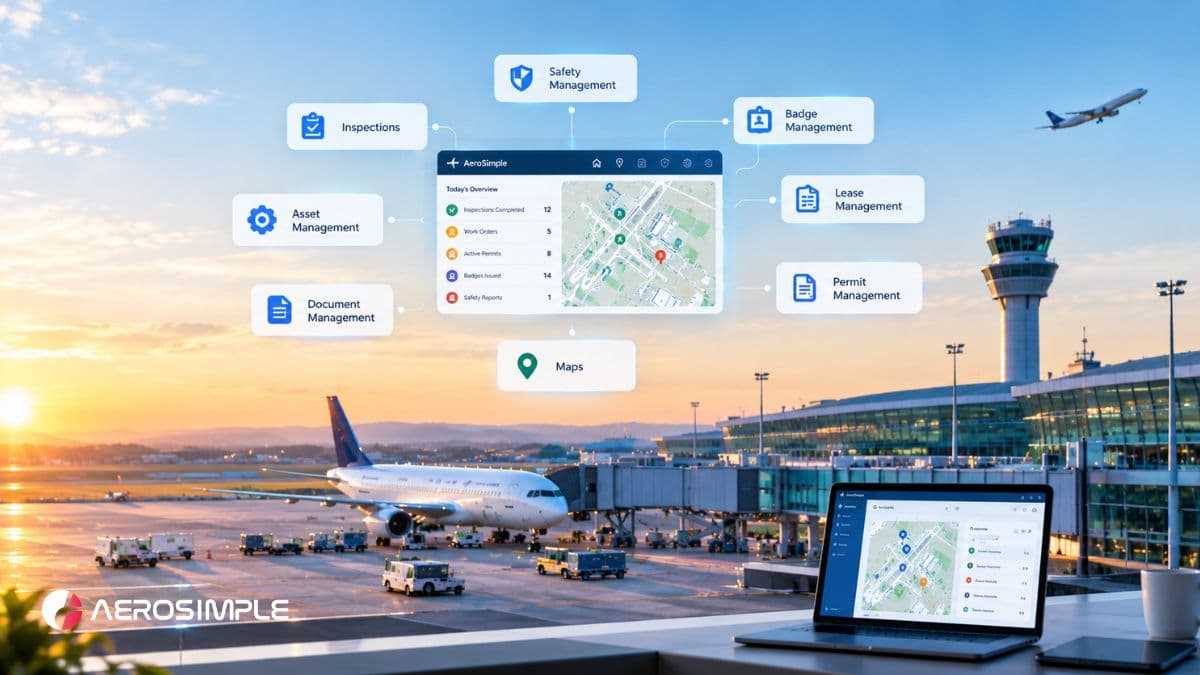
By evening, the operations manager can look at a single view of the airfield — every inspection completed, every badge issued, every open permit, geographically placed — without stitching it together from five different files. Not because someone compiled it for her, but because every team fed the same system throughout the day.
That's really the quiet promise of airport digital transformation: not fewer tasks, but no version of the truth to argue about.
How AeroSimple Makes This Possible
Everything in this scenario — the inspection that becomes a work order automatically, the asset that carries its own history, the badge that checks lease and permit status in seconds, the safety report that reaches the right person instantly, the single map view at the end of the day — comes down to one thing: Inspections, Asset Management, Badge Management, Lease Management, Permit Management, Safety Management (SMS), Document Management, and Maps all living on one connected platform instead of scattered across spreadsheets, inboxes, and paper forms.
AeroSimple was built around exactly this kind of day. Not by adding more software for airport teams to manage, but by making sure the systems they already rely on actually talk to each other — so information moves as fast as the people who need it.
See what a connected day at your airport could look like. Book a demo today.
Frequently Asked Questions
Why does real-time reporting matter more than periodic reports?
Real-time data lets teams catch and fix issues as they happen, rather than discovering them days later in a scheduled report. This is especially valuable for anything safety or compliance related.
How does integrated airport software improve daily operations?
Integrated airport software connects information across multiple functions, helping teams access the context they need without switching between disconnected systems. This can reduce manual work, improve visibility, and support faster decisions.
How does airport asset management improve maintenance?
Airport asset management keeps asset details, service history, repairs, and related information in one place. Maintenance teams can access this information when work is created, helping them make faster and more informed decisions.
How does real-time data support airport decision-making?
Real-time data gives airport teams a current view of inspections, work orders, safety events, permits, and other operational activities. This helps teams respond to issues sooner and make decisions based on current information.
How can airports connect information across departments?
Airports can connect departments through a unified platform that links workflows, records, and operational data. This reduces information silos and creates a shared source of truth across teams.